
In the wake of the current economic recession, employment prospects seem mediocre at best. Recent large-scale layoffs seem to be unfavorable indicators of employment for recent and future college graduates. While the current economic atmosphere can certainly be disheartening, there are jobs out there. If you’re in the market for a new position, you may want to consider alternative career routes that can offer lucrative and fulfilling roles.
In recent years, the term social entrepreneurship has been used to describe ventures that “generate some of their own revenues and use business techniques to address social goals.” Essentially, such projects are non-profits that apply smart business practices in order to achieve the highest level of social impact.
Drew Chafetz, a University of Colorado graduate, is an example of a young social entrepreneur. Chafetz created his own nonprofit organization called love.futbol at the age of 25. Love.futbol aims to bring soccer fields to impoverished communities where recreational space is scarce. To date, this organization has built three fields in Guatemala.
Projects such as the one established by Chafetz are not trifling affairs. According to the Washington Post, over 30 business schools have established social entrepreneurship programs. Pamela Hartigan, author of “The Power of Unreasonable People: How Social Entrepreneurs Create Markets That Change the World,” believes a certain business sense allows those like Chafetz to achieve more with respect to their social endeavors. “Young people today…believe that change is going to be brought about by business and market discipline,” says Hartigan.
Even those who are typically viewed as stakeholders in the profit-driven business world are singing the merits of social entrepreneurship. Bill Gates, co-founder of Microsoft, is a proponent of nonprofits that practice business strategies. According to Gates, “creative capitalism” can result in increased social impact. If you’re entering the workforce and have an interest in social issues, you may want to consider researching social entrepreneurship. Amidst the current atmosphere of shrinking job opportunities, the social enterprise realm continues to flourish.
Thursday, December 11, 2008


Monday, December 8, 2008
Spare Change: The New Retirement Estimator
 Social Security's new online Retirement Estimator was named the best online service in government, according to the American Customer Satisfaction Index for Federal Websites. Debuting on the Index with an impressive score of 90, the new retirement estimator was honored with the second highest score received by any government website or online service ever. Check it out today: click here.
Thursday, December 4, 2008
Money-Minded Gifts: Finance Books
Holiday gift shopping may be hurting more than your checking account this winter. A new study shows that Christmas shopping increases blood pressure to dangerous levels in 50% of holiday shoppers. When researchers tested men and women after having them buy gifts, women were three times more stressed than they had been before shopping.
It's hard enough to try to find the perfect gift, and braving crowds and cold weather can make shopping feel especially stressful. When you combine these factors with a tighter budget, it's no wonder that shoppers' heart rates increase by 10% while shopping during the holiday season . But if you're feeling financial pressure, chances are the people you're shopping for are experiencing similar money-related stress. So why not channel your shopping anxiety into a helpful, money-minded gift? This w eek, we're taking a look at finance books. In 2008, 52% of consumers' New Years resolutions were related to getting out of debt. Help your friends and family get a jump start on improving their financial situations by giving them a personal finance book this holiday season.


It's hard enough to try to find the perfect gift, and braving crowds and cold weather can make shopping feel especially stressful. When you combine these factors with a tighter budget, it's no wonder that shoppers' heart rates increase by 10% while shopping during the holiday season . But if you're feeling financial pressure, chances are the people you're shopping for are experiencing similar money-related stress. So why not channel your shopping anxiety into a helpful, money-minded gift? This w
 eek, we're taking a look at finance books. In 2008, 52% of consumers' New Years resolutions were related to getting out of debt. Help your friends and family get a jump start on improving their financial situations by giving them a personal finance book this holiday season.
 Get a Financial Life: Personal Finance in Yours 20s and 30s by Beth Kobliner:
This book is a smart choice for any person who is new to managing her finances or who is interested in managing her finances in a more responsible way. Get a Financial Life is exceptionally thorough but never dull or overwhelming. For the most time-strapped readers, Kobliner offers a "Financial Cramming section" at the end of each chapter to summarize the chapter's most important ideas.

The Number: A Completely Different Way to Think About the Rest of Your Life by Lee Eisenberg
The number is a less a retirement guide than a reflection on issues facing the aging population. Eisenberg is a journalist, not a financial planner, but his experience writing on the topic is evident. According to Eisenberg, everyone should be thinking about his or her "Number," which is the amount of money required to meet an individual's expectations for life in retirement.
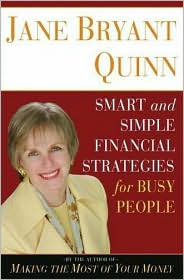
Smart and Simple Financial Strategies for Busy People
by Jane Bryant Quinn
Jane Bryant Quinn is informative and charming in this book. She covers all the bases, but perhaps the most helpful chapter is "Putting Your Whole Financial Life on Cruise Control"-- the idea being that money saved automatically is less likely to be spent frivolously. Shifting to automatic saving can save you both time and money. Quinn's personal stories of struggling with debt make this both an enjoyable and worthwhile read.
Next Week's Money-Minded Gift: Online Savings Accounts (coming Thursday)
Bags of Stress: Why Christmas Shopping is Bad for Your Health via The Daily Mail Online
2008 New Year's Resolutions Signal Shift in Consumers Priorities via MyGoals.com
Wednesday, December 3, 2008
Deck the Halls with W2 Forms and Tax Returns: College Aid Season 2009
The conclusion of Thanksgiving last week, as always, was marked by a barrage of holiday themed commercials, signifying via your television set that it officially ‘tis the season to be jolly. If you’re a college student eagerly awaiting the end of Fall classes and the opportunity to sloth it for a whole month, the term “the most wonderful time of the year” never rang truer. However, take care not to lose sight of all of your responsibilities. January 1 marks the beginning of the “college-aid season,” and with it comes the ubiquitous FAFSA (Free Application For Student Aid). If you are looking to receive any type of aid, it is important that you file as soon as possible.
No one wants to spend the first day of the New Year filling out 6 pages worth of financial information. In fact, Congress passed legislation in August that aims to drastically minimize the currently daunting FAFSA form by 4 pages. Unfortunately for current college students, you are going to have to stick it out for one more year as this two-page form will not be offered until 2010.
One of the best ways to make the task tolerable is to be prepared; before January 1, gather all of the documents you will need in order to fill out the FAFSA. These include:
1. Social Security Number,
2. Driver’s License (if you have one),
3. 2007 W-2 Forms,
4. You and Your Spouse’s (if applicable) 2007 Federal Income Tax Return (IRS 1040, 1040A, 1040 EX, Foreign Tax Return or Tax Return for Puerto Rico, Guam, American Samoa, the US Virgin Islands, the Federal States of Micronesia or Palau),
5. Parents’ 2007 Federal Tax Return (if dependent),
6. Current bank statements,
7. Current business and investment mortgage information, business and farm records, stock, bond and other investment records,
9) 2007 Untaxed income record (social security, Temporary Assistance for Needy Families [TANF]. Welfare, veterans benefits records), and
10) Alien registration or permanent resident card (if not a U.S. citizen)
Once you’ve gathered these materials, you can print out a “FAFSA on the Web Worksheet” from fafsa.ed.gov. Filling out this worksheet by hand preliminarily will allow you to simply transfer the information onto the online application when it becomes available. After you fill this worksheet out, you can sign the FAFSA electronically using a PIN (Personal Identification Number) or by mailing in the signature page of the document. Your aid eligibility will be made available immediately once you have submitted your application.
Depending on your Expected Family Contribution (calculated using the Federal Methodology), you may be eligible for Pell grants, student loans and college work-study programs under federal aid. Many schools and states also use the information from the FAFSA to calculate any aid they may award you. Thus, it is crucial that you fill out the form as early as possible. The deadline for filing is June 30th but make sure you check your state deadlines as some are earlier than the federal cut off date.
Getting a head start on the FAFSA process will allow you to avoid any procrastination-induced stress. Visit the FAFSA web site at www.fafsa.ed.gov to find out more information including whether or not you may be able to apply as an independent and other FAQ’s.
No one wants to spend the first day of the New Year filling out 6 pages worth of financial information. In fact, Congress passed legislation in August that aims to drastically minimize the currently daunting FAFSA form by 4 pages. Unfortunately for current college students, you are going to have to stick it out for one more year as this two-page form will not be offered until 2010.
One of the best ways to make the task tolerable is to be prepared; before January 1, gather all of the documents you will need in order to fill out the FAFSA. These include:
1. Social Security Number,
2. Driver’s License (if you have one),
3. 2007 W-2 Forms,
4. You and Your Spouse’s (if applicable) 2007 Federal Income Tax Return (IRS 1040, 1040A, 1040 EX, Foreign Tax Return or Tax Return for Puerto Rico, Guam, American Samoa, the US Virgin Islands, the Federal States of Micronesia or Palau),
5. Parents’ 2007 Federal Tax Return (if dependent),
6. Current bank statements,
7. Current business and investment mortgage information, business and farm records, stock, bond and other investment records,
9) 2007 Untaxed income record (social security, Temporary Assistance for Needy Families [TANF]. Welfare, veterans benefits records), and
10) Alien registration or permanent resident card (if not a U.S. citizen)
Once you’ve gathered these materials, you can print out a “FAFSA on the Web Worksheet” from fafsa.ed.gov. Filling out this worksheet by hand preliminarily will allow you to simply transfer the information onto the online application when it becomes available. After you fill this worksheet out, you can sign the FAFSA electronically using a PIN (Personal Identification Number) or by mailing in the signature page of the document. Your aid eligibility will be made available immediately once you have submitted your application.
Depending on your Expected Family Contribution (calculated using the Federal Methodology), you may be eligible for Pell grants, student loans and college work-study programs under federal aid. Many schools and states also use the information from the FAFSA to calculate any aid they may award you. Thus, it is crucial that you fill out the form as early as possible. The deadline for filing is June 30th but make sure you check your state deadlines as some are earlier than the federal cut off date.
Getting a head start on the FAFSA process will allow you to avoid any procrastination-induced stress. Visit the FAFSA web site at www.fafsa.ed.gov to find out more information including whether or not you may be able to apply as an independent and other FAQ’s.
Tuesday, December 2, 2008
Medicare Prescription Drug Plan Open Season

Tis' the season...to apply for Medicare's prescription drug plan. Open season began November 15 and continues through December 31. During open season, new Medicare beneficiaries can join a prescription drug plan, while current beneficiaries should take this time to review the plan they're enrolled in. This is also a prime time to find out if you're eligible for Extra Help. Extra Help is available for beneficiaries with a limited income and provides those who are eligible with financial assistance for monthly premiums, annual deductibles and prescription co-payments. You can apply for Extra Help if:
1)You have Medicare Part A (Hospital Insurance) and/or Medicare Part B (Medical Insurance); and
2)You live in one of the 50 states or the District of Columbia; and
3) Your combined savings, investments, and real estate are not worth more than $23,970, if you are married and living with your spouse, or $11,990 if you are not currently married or not living with your spouse. (DO NOT include the home you live in, vehicles, personal possessions, burial plots or irrevocable burial contracts.) If you have more than those amounts, you may not qualify for the extra help. However, you can still enroll in an approved Medicare prescription drug plan for coverage.
For more information on Medicare prescription drug coverage, including applications for Medicare and Extra Help, visit the Social Security website.
Monday, December 1, 2008
Spare Change: 401(k) News
In this edition of spare change, we (quickly) explore what's happening in the wild world of 401(k)s. Have some spare change of your own? Share your 401(k) headlines in the comments!
- The Employees Benefit Research Institute (EBRI) is offering regular updates of 401(k) balance estimates as the markets change based on information from their database, which is widely recognized as the most comprehensive database on 401(k) plan participants. To find out more, click here.
- Interested in 401(k) fee disclosure regulations? Check out this webinar next week, which features Mass Mutual as well as various financial firms.
- This year, 2009, you will have the opportunity to save more for retirement in your tax-sheltered account than you did last year. You and your employer may contribute more to your qualified retirement plan because an increase in the cost of living index triggered an “adjustment” in the limits. The 2009 Plan limits are listed below:
| New Plan Limits for 2009 | ||
| | This year 2009 | Last year 2008 |
| 457(b) deferral [457(e)(15)] | $16,500 | $15,500 |
| 401(k) & 403(b) Elective Deferral [402(g)(1)] | $16,500 | $15,500 |
| Age 50+ catch-up Contributions | $5,500 | $5,000 |
| | | |
Savings Tools
Need a little help putting money aside this holiday season? Try one of these handy online tools and create a savings plan that works for you.
CNN Money Savings Calculator: This tool calculates your savings by having you answer a brief series of questions about your taxable accounts, tax-deferred accounts and projected rate of return/time frame. Quick and simple, this calculator offers you an estimate on how much you will save as well as a variety of other retirement savings related tools.
Mint: Mint.com touts itself as "the best free way to manage your money." Wall Street Journal seems to agree with this assessment, calling Mint "a pleasure to use." Mint offers you tools to help save for retirement, pay off your debt, and save for long term goals. By entering your information, this personal finance software automatically downloads and categorizes your credit card transactions nightly to help you identify your spending trends.
Choose To Save calculators: EBRI's Choose to Save campaign has a page chock full of calculators to help you save, as well as tools to assist you with your employee benefits, insurance, Roth IRAs and more. They also recommend their favorite savings calculators from other sites such as Motley Fool and FINRA.
CNN Money Savings Calculator: This tool calculates your savings by having you answer a brief series of questions about your taxable accounts, tax-deferred accounts and projected rate of return/time frame. Quick and simple, this calculator offers you an estimate on how much you will save as well as a variety of other retirement savings related tools.
Mint: Mint.com touts itself as "the best free way to manage your money." Wall Street Journal seems to agree with this assessment, calling Mint "a pleasure to use." Mint offers you tools to help save for retirement, pay off your debt, and save for long term goals. By entering your information, this personal finance software automatically downloads and categorizes your credit card transactions nightly to help you identify your spending trends.
Choose To Save calculators: EBRI's Choose to Save campaign has a page chock full of calculators to help you save, as well as tools to assist you with your employee benefits, insurance, Roth IRAs and more. They also recommend their favorite savings calculators from other sites such as Motley Fool and FINRA.
Subscribe to:
Comments (Atom)

